
Quinuituq
The rhythm of the arctic

Monday morning was suspiciously mild, with enough breeze to keep midgies at bay but nothing too fresh, the kind of day you might think would be good for sailing, if you hadn’t looked at the forecast. Then Bernard sent a message to say he’d be up to oversee a delivery. Not just any delivery, but the arrival of all the windows and doors.
Of all the days for twenty-thousand pounds-worth of glassware to need unloading from a lorry and stacked for safe-keeping, the supplier chose one with a forecast of 80 miles per hour winds. There was me worrying, in my last post, about the piles of wood lying around at the house site, but this paled into insignificance beside the big sliding door panels, the vast picture windows, the floor-to-ceiling panes that will give us the fabulous views from our living space and bedroom. They’re chunky and made to last for decades, once installed, but teetering on the truck they looked so fragile, far too easy to topple and smash, vulnerable to flying objects that could so readily shatter them.
So Monday morning involved several hours of intense activity, unloading, stacking, stropping, with Bernard checking each panel so he could sign them off, Andy gingerly lifting each palette of panes off the lorry with the forklift, Shane and John working at ground level to stabilise them, the lorry driver looking on, regaling us with stories of other mad decisions by the same supplier, a neighbour waiting for the forklift to become available for his urgent pre-storm job, Bill and I trying not to get in the way, everyone aware of the wind steadily rising.
By the afternoon everything was tied down and the breeze grew to a near gale, then a full gale, gusting storm. As the wind veered from south to west, gusts of severe storm 11 were suddenly blasting up the sea loch. Bill went down to Lochinver to check on our boat but the loch was boiling white water and the pontoons far too dangerous to venture out onto. He took the anemometer and recorded 75mph in the harbour. Fortunately up on the house site, the lie of our land was giving us a modicum of shelter.
Trees roared. Powerlines shrieked. The air was thick with salt spray. But nothing gave way. Nothing blew down. Nothing was broken.
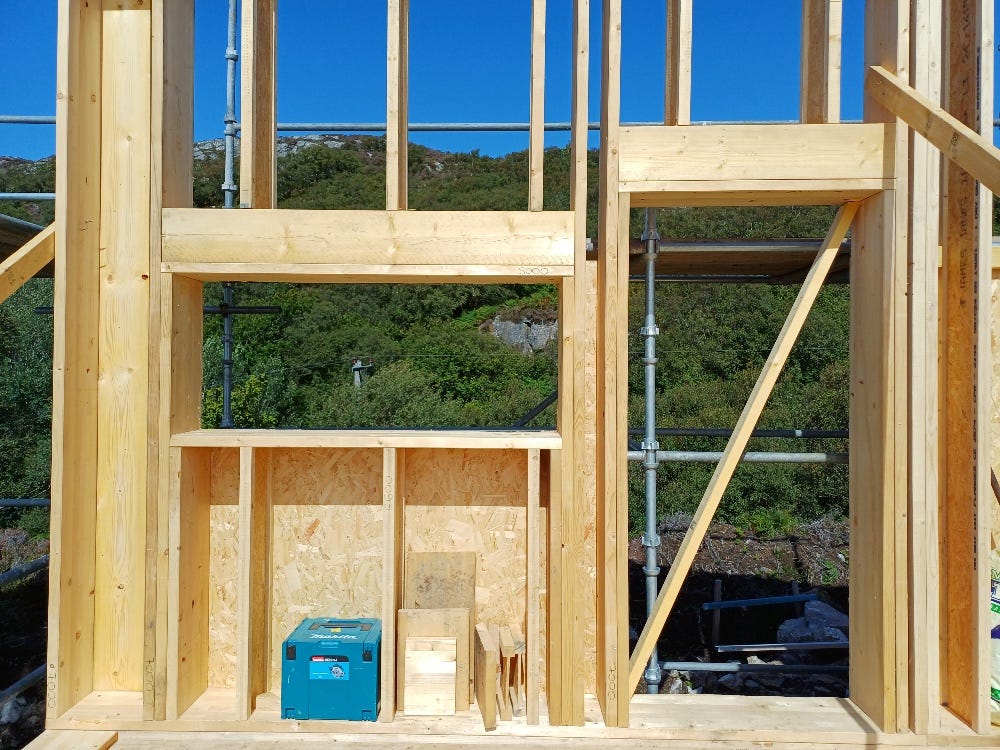
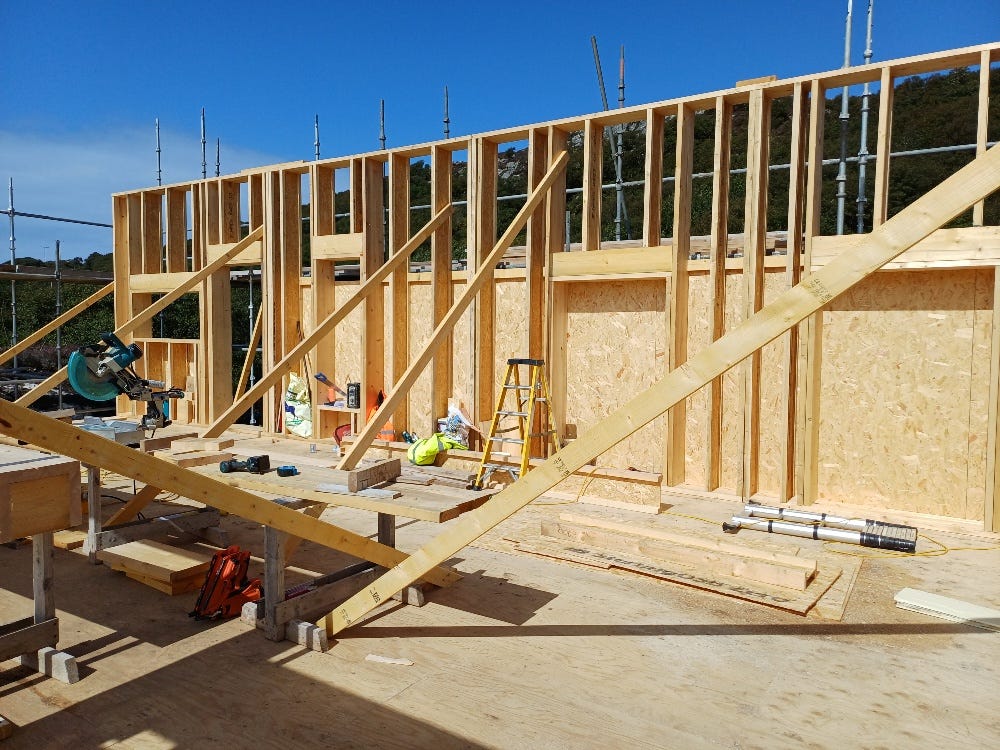
Next morning, as if nothing untoward had ensued, Shane, John and Andy started raising the walls. To volleys of nail gun percussion, stacks of timber were danced together into 3-dimensional structure. By the end of the day, the house had a north wall. By Wednesday the east wall had joined it. Thursday gave us the bedroom frame and by close of day on Friday it’s possible to pad around and look out of the empty frames of all the windows and doors. From nowhere, in no time, the skeleton of the house is in place.
On a trip to the Arctic more than a decade ago, I learned the Inuit word, Quinuituq, which expresses the pace and rhythm of activity in far northern environments: the long, slow wait at an ice-hole with a dangling line, followed by the frantic activity when a fish bites; the almost endless frozen state of glacier ice until it suddenly thaws and calves and makes a tumult of waves. A good story too, or a compelling film, is paced with lulls, quiet bits where nothing much is happening, interrupted by rapid-fire action.
So too, it seems, the building of our house.
Any of us who have been "there" at these stages of house construction, especially on a wild site, know this rhythm!